
Football Trading: Best Strategies for Betfair Profits
The arrival of the Betfair Exchange way back in 2000 changed the world of football betting forever.
 More importantly, the creation of a marketplace where punters could exchange bets with each other instead of relying on a bookmaker, gave birth to a completely new concept: Football Trading.
I began trading football for a living over a decade ago now, and this site has become a labour of love since originally setting it up just to publish my daily selections.
I genuinely enjoy helping people learn how to trade, and I have helped many do so over the years. So if you're interested in becoming a profitable football trader, this article is for you.
I will outline the basic foundations, then I'll explain how to achieve genuine success using the best Betfair football trading strategies, the exact methods I have years of experience using myself.
What Is Football Trading?
 When I tell someone I'm a football trader, they often mistakenly assume it's just a 'fancy' way of saying I gamble on football matches. But this couldn't be further from the truth.
As many of you know, long before I started trading on sports markets, I had a background in commodities and stocks. (Spread betting)
Yes, some of you know I also had a bit of a, hmm, let's call it an 'affinity' for gambling in my youth! But those days were over long before I first joined Betfair's sports betting exchange.
Betting was fun. Trading is business.
Football trading is virtually identical to stock trading. It is for me anyway:
- I research and gather data to form an opinion on which direction the market is likely to go.
- I make an informed decision to open a position based on that opinion.
- I then watch and wait for a profitable scenario to arrive.
- I then close my position and bank my profits, concluding the trade.
Sure there are plenty of minor differences, such as the hours or the fact I now have to fight over the TV remote more than I used to, but the essential dynamics are very much the same.
Where I once 'bought and sold' shares, I now buy and sell bets on football games.
There are only two significant differences I can think of:
1. Market Duration
 Stock markets never end. They may pause during overnight closures, but the charts and trading carries on the next morning, right where it left off the day before.
On Betfair, football markets end (completely and permanently) with the final whistle.
While that can feel a little different, in practice it makes no difference at all, except for adding a bit more excitement!
You know when it ends so you just close your trades beforehand, then move on to another market to search for new opportunities to bank profits.
2. Market Volatility
As everyone in the market is aware that it closes after 90 minutes has been played, the result is finite.
There are a few possible outcomes, and the odds on the correct outcome have to come down to the lowest possible odds (1.01) before that final whistle is blown. As a result, the prices (odds) move an enormous amount during that 90 minutes of play.
 This presents a huge advantage over the much more 'sedate' stocks type markets, which trickle in one direction or the other forever. It was this point which first piqued my interest in trading on Betfair many years ago, as the potential for profit is significantly greater thanks to those pretty wild price movements.
If you get it right, you can do very well indeed, and there are many other people successfully earning a full time income from football trading. Of course on the other hand, if you don't know what you're doing, the potential for substantial losses is equally obvious.
Let's move on to the dynamics of a betting exchange and how this enables football trading to exist.
(Note: If you're already feeling confused, please stop and read my detailed beginner's article explaining the basic principles of Betfair trading before going further.)
How Football Trading Works
I want to make sure people understand a couple of fundamental principles before I explain the actual trading strategies themselves.
I think it's irresponsible to just throw out some 'trading systems' because people often rush off to try using them straight away, before having a full understanding of the underlying forces at work.
Betting Exchange Mechanics
 In a bookmaker's shop you can only ever back an event, for instance 'Sunderland to win'.
That 'outcome' is what you are betting on, by backing it.
When you back something, and the bookie takes your bet, he is actually laying that same event.
He's taking the 'opposite side of the book' from the side you're on. Thus he 'makes a book', hence the term 'book-maker'.
Which leads me to the only essential thing you need to know about a betting exchange: You can now place those lay bets yourself, something we could never do before the arrival of the exchange.
Now that you can place both a back and a lay bet on the same outcome, trading becomes possible. Backing and laying can be equated to buying and selling, and so if you were to 'buy' a bet and then 'sell' it for a higher price, you make a profit.
What's more, you can do it in either order. You can lay first to open a position and then back to close it, or vice versa. Which means you can make money if the price rises, or falls.
Of course it might help if you had an idea how to work out whether the prices will rise or fall! And you soon will, patience is a virtue! (Especially in trading!)
The Mechanics Of A Trade
 This will be explained more carefully when we go through each trading strategy in detail, but every trade will consist of these four essential steps:
- Open a position
- Await a profitable scenario (due to odds movements)
- Close your position
- Green up to guarantee your profit is banked
If you expect the odds to shorten, you will perform the first step (opening a position) by backing first, and then laying the same outcome to close the trade.
If you expect the odds to go up, you do things in the opposite order, laying an outcome first followed by backing it to close the trade.
2 Types of Football Markets
Football markets are open for trading from the moment Betfair publish them on their website. This could be the day before kick-off, or days or even months before.
From that moment onwards bets can be placed on the game (which means trades can too). Between the opening of the market and the kick-off, the market is described as a 'pre-market'. It's also referred to quite often as a 'Pre-Match' market.
When the game starts, the kick off marks the change of that 'pre-market' into an 'in-play' market.
The two markets are not separate, it's not like one stops and the other starts, it's a seamless transition where the pre-market just carries on but Betfair mark their webpage for that market with an "In-Play" icon so people know the game is underway. If you use football trading software then you will also get an audible alert and a visible marker on your trading screen.
N.B. The reason I mentioned this here is because the factors which cause prices to change are different, depending on whether you're looking at the pre-match or in-play markets.
Price Influences: Why Odds Change
There’s only one reason prices for goods ever move up or down: Money.
If more people want to buy than sell, the price will go up, and vice versa. Nothing moves in any market without buyers and sellers coming together on newly-agreed ‘fair’ prices for any 'exchange' of goods. The goods in this case are bets, as already explained.
 Everyone wants value, it will never change and it applies both to buyers and sellers.
If you sell your car, you want a ‘good’ price. When you’re buying one, you also want a ‘good’ price.
The definition of ‘good’ is in the eye of the beholder, of course. And whilst one individual might be fooled from time to time, the collective views of a large group of people are always spot on. This is how all commodities in all markets quickly find their 'right price’.
The more liquidity (money/people) that are involved in any marketplace, the more accurate and stable the prices become. This is simply because if someone offers a price that's considered 'too cheap', a ton of buyers will arrive to get as much 'stuff' as they can at such a 'cheap' price, and up go the prices until the buying frenzy slows down.
This is the most fundamental law of 'market dynamics', and as a football trader it's useful to be aware of it, especially when deciding your entry (buy) and exit (sell) prices for your trades.
Probabilities
On Betfair football markets there are two probability figures to be aware of:
- True Probability
- Implied Probability
True probability is the real world likelihood of any outcome, such as Chelsea to win against Manchester City. Implied Probability is a simple conversion from the decimal odds to find out the probability 'implied' by the odds they are priced at.
 You can look at a team's odds to win a game, convert that to I.P. (as a percentage), and then make a judgement on whether you think it's accurate, especially after looking at their form and scoring statistics.
As the picture shows, it's a very simple calculation. The lowest price any outcome on Betfair can have is 1.01 (decimal odds). 100 divided by 1.01 equals 99. So the current market price 'implies' that the outcome has a 99% chance of taking place.
Similarly, the highest odds you will see on Betfair are 1000, which converts to an I.P. of 0.1%.
This is something professional gamblers take into account, and you can see why. If the odds reflect an implied probability of 50% but the stats suggest their real world chances of winning are closer to 80%, you might have a nice 'value bet' on your hands!
But for football trading purposes, especially if trading 'pre-match', we're not as fixated on the real world probabilities as we don't care about the actual outcome of the match.
We just want to judge the likelihood of price movements and direction during our trade.
Any noticable difference between real probability and I.P. can be useful, as if they are wildly different there is a strong likelihood that the 'market' will 'correct' fairly quickly, giving us the likely direction.
We know the prices on Betfair are governed ultimately by what ‘people’ collectively think about the probability of any particular outcome. So let's look at the factors which influence people’s views.
Before Kick Off
Here are the main factors determining price movements before the game starts:
Key Players
 All teams have a few crucial players.
Usually it's their centre-forward (striker) who does most of the scoring, combined with a strong midfielder who sets up those attacks and helps the team retain possession.
Whilst football is obviously a team game, a hot or 'on-form' striker is vital to their goal scoring abilities and thus to their success in the league or competition.
But these 'key players' are not always playing, sometimes they have injuries, sometimes the game is not considered 'difficult' enough to risk fielding such an important player.
In other words the manager decides they can win without their 'Van Persie' or whoever it may be, perhaps to prevent them being injured before a more important game.
If you were paying the obscene £200,000 per week salary of your lead striker, you'd probably feel the same way!
Keeping abreast of team news and checking the team sheets (which shows who will be playing in an up-coming game) is worth doing, especially when planning on trading any football match.
The betting markets (or more accurately the punters involved) are pretty savvy these days and so, if a key player is missing from a line up, their odds will likely be affected.
Recent Form
Form is an obvious influence on odds as most gamblers know how their team is performing. The most recent form is a particularly influential factor. If a team has struggled recently, even if only for the last few games, you can be sure the market will account for it in their odds.
In the past I remember quite a few times where I planned to trade a game but was then surprised by the odds being higher or lower than I'd expected. Nearly every time, a brief look at the recent form of the teams involved would explain why.
Home or Away
 Teams get more support from their fans when they play at home rather than away on enemy territory.
It's sometimes referred to as the "home advantage", and it makes a massive difference to the odds.
Over the many years I've been trading Betfair football, I've seen what a difference this can make.
Sometimes, especially in Spanish LaLiga matches, a home team might be around 1.5, yet when they play the same opponent away from home their odds can be well over evens (2.0), even as high as 2.5.
Weather
It's not the biggest price influence but it definitely can affect the odds. I think the two main reasons are:
1. When the weather is cold, snowy or miserably wet (think Newcastle in February!) fan attendances can drop quite a bit, understandably too. What can be a great day out for a footie family doesn't look quite so appealing when it's raining cats and dogs!
This reduced interest in watching a game naturally causes a reduction in interest in betting on it. And this of course affects the prices.
 2. Wet sloppy pitches don't generally make for a good game.
The ball is slippery, the playing surface is slippery, even the players are slippery!
Passing becomes less accurate which can impact the efficiency of a team to build up enough passes to create goal-scoring opportunities.
I have seen odds affected by sudden changes in the weather for this very reason.
After Kick Off
Once the game kicks off and the market 'goes inplay', the most influential price factors are:
Goals
When a team scores a goal, their odds can drop by half or more.
Likewise, if a very strong and heavily-bet team fails to score as expected, their price will climb rapidly, especially in the second half. This is because the pre-kick-off prices were 'factoring in' their goal scoring prowess, and so the market has to 'correct' in-play to account for their failure to do as expected.
And if you're sat there thinking: "And the implied probability needs to continue to 'track' the real world probabilities too, which are reduced if the favourite is struggling to score", that's a gold star for you!
Time Decay
 I think this would be better termed 'Price Decay' (due to time), but time decay won the title of 'accepted term' for some reason!
(If only they'd asked me, always the bridesmaid, never the bride. 😀 )
Everyone knows the game ends after 90 minutes so prices always reflect the time left in the game, and the changing probabilities.
At the end the market ceases to exist and all bets are settled. The time decay influence on prices grows through the game, getting more and more influential the closer it gets to the final whistle.
Red Cards
I have had more than a few trades 'ruined' by a (bluddy) red card!
In a team of 11 players, losing one is catastrophic. That in itself wouldn't be such an issue, as many teams still play pretty well despite having a player sent off.
The problem comes with how teams, especially their managers, respond to the event.
It's fairly standard practice for a team to go into 'survival mode', where they stop being aggressive or taking risks to score, and instead just focus on defending their own goal.
Many teams, even when they are the favourites to win, decide to settle for a draw if they get a red card.
It's obviously bad news (and an exit trigger) for just about any trade, unless you're trading a red card strategy of course!
Hopefully you're now aware of most of the price influences in football markets, both before and after kick off. It should come as no surprise to hear that the best Betfair football strategies usually take the above factors into account during both the trade selection process and the live trades themselves.
My football trading systems certainly require at least one check of weather, team sheets, and above all the recent form stats. Trading without this easily-obtained information is just lazy, and opens the door to unnecessary risk. I don't mind risk, but any good trader should utterly detest unnecessary risk!
Ok, you've been patient enough! Now let's get into the strategy stuff.
Best Football Trading Strategies
There's a wide variety of soccer systems. Some are low-risk strategies, others are much higher risk. I'm not a big fan of high risk strategies for trading any sport because of my own past experiences.
Risk Aversion
We all have different tolerances for risk. Mine is pretty low, but it wasn't when I first started trading.
During my first 12-18 months as a full time football trader I tried more strategies than I can even remember. Some were pretty high risk. There is nothing wrong with taking big risks, so long as you can accept the inevitable heavy losses you will sustain from time to time.
I thought I could handle that, but it turned out I was wrong!
 A large part of learning to be a successful trader is learning about yourself, in particular your own risk appetite, psyche, emotional stability and more. I found out (the hard way) that I don't trade well when I am under immense pressure.
I wanted to, I just didn't, and I had to acknowledge that fact if I wanted to keep on growing as a successful football trader.
I blew my entire trading bank... more than once.
This is why I often tell traders who are struggling that I really have 'been there'. I have walked every walk, and worn every T-shirt, plus a few I had printed just for me!
A trader friend once asked me:
"What would you say was the key to you becoming successful in the markets?"
My answer went something like this:
"I spent many months learning every possible mistake a trader can make, then I spent many more months learning how to STOP bloody making them!"
Low Risk Strategies
As a result of discovering my sub-conscious aversion to risk, I decided to gear my football trading strategies around lowest possible risk for maximum possible return.
Many people 'talk' about doing that, but in my experience not many traders actually do it.
You have to be genuinely capable of turning down strong trading opportunities, purely on the basis of the total risk being outside your comfort zone. I found it very hard to do, but the memory of decimating a trading bank (of several £Thousand) is remarkably good at helping us learn!
I am not saying I don't like risk, or I don't take any risks. Of course I do, I am trading, and without risk there would be no trading!
I just try to keep my risk within the boundaries of what I know I can emotionally tolerate. In other words, before every football trade I ask myself:
"What is the absolute worst possible outcome here?"
If I don't think I will be able to handle the answer, I cancel the trade there and then. And I smile as I do so, because bitter and painful experience has taught me that I am doing a good thing and protecting myself and my future as a trader, not to mention my trading bank.
Pre-Match Strategies
 Generally speaking, trading before kick off is lower risk and also lower profit than trading during the live play.
Over the years I must have spent thousands or tens of thousands of hours just watching nice stable pre-match markets and pinching a few ticks here and there.
It's a great way to learn about the price movements (price dynamics) in football markets, and it's extremely useful for beginner traders to get used to the backing and laying process and see how the prices of each outcome relate to each other.
Bookmaking
This has a special place in my heart and many fond memories, as it was the very first strategy I ever used to trade football markets on Betfair, and it got my bank growing gradually but safely while I learned both about the markets but also about trading software.
The trading profits are small, but with a good-sized bank you can rack up substantial cumulative profits with these sorts of trading methods, and with extremely low risk. It's what I would call a very low risk, beginner-friendly 'bank builder' strategy.
To make a book you simply lay all possible outcomes on any event.
So in a football match you'd be laying both teams and the draw, totalling 3 lay bets.
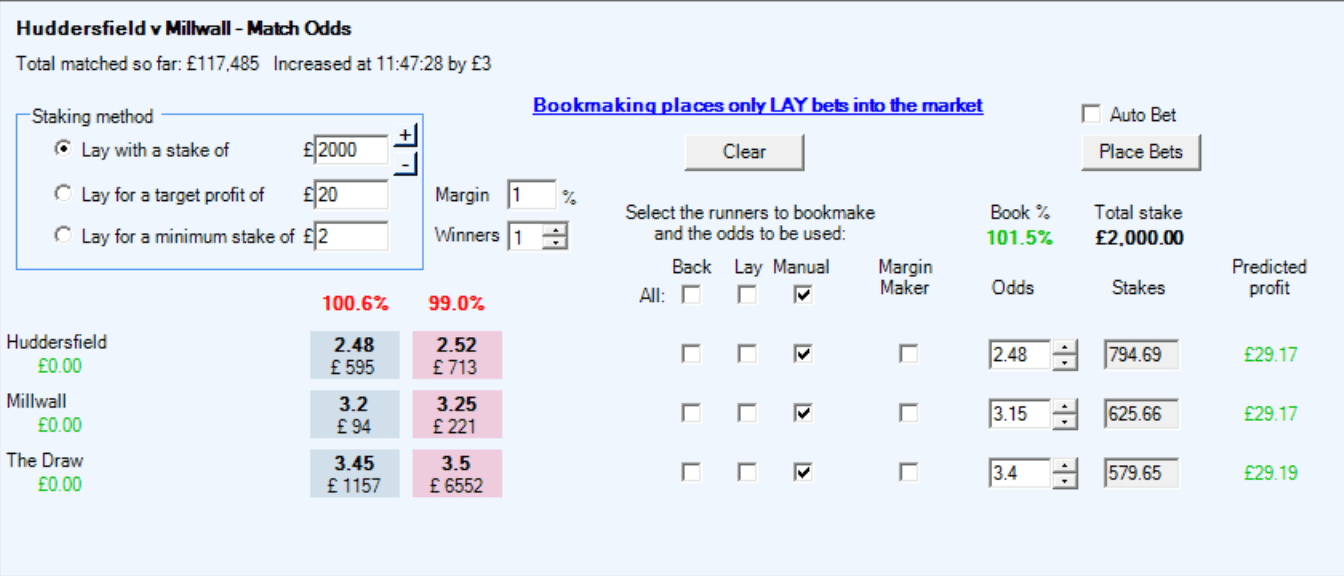
Of course you must get all three lay orders matched to make a profit as you 'complete the book'.
But there are plenty of options for when you can't get all three matched, which is how my approach to bookmaking evolved. If I can't complete the book, I morph the trade into a mix of scalping and range trading.
There's a full explanation in my article: Bookmaking on Betfair.
Dutching
This is just the reverse of bookmaking. Instead of laying all outcomes, you back them all, again at favourable prices to secure a guaranteed profit.
Just like making a book, the profits are small but add up, as you can use either of these strategies on just about any football market with sufficient liquidity to stabilise the market long enough to get your orders matched and complete the trade.
One important point to note is that dutching has the advantage of needing less trading funds available, as backing needs less money than laying due to the reduced liability
A £1000 back order on a team who's odds are 3.4 will 'lock' £1000, as that's all you're risking (if you were betting, which you're not, this is a pre-match strategy remember!)
However a £1000 lay order at 3.4 will lock the much bigger sum of £2400, leaving you less money available for other trades (or orders within the same trade).
 Please note, many people use the term 'dutching' to refer to a 'system' (if you can call it that!) of backing various outcomes. A common example would be betting on the correct scores market.
Some beginners (who want to become Betfair traders, not gamblers) are led astray by these kinds of ideas, where they are encouraged to back various scorelines in the 'hope' that one of them comes in.
I don't care even if it's done with the aid of form and goal statistics, it will never be 'trading' from my point of view.
Betting on various outcomes simply increases your chances of winning your 'gamble', whilst reducing the potential profits. It's swings and roundabouts, or 6 of one, half a dozen of the other!
It's just betting, there's no other word for it, neither 'trading', nor 'dutching'. To dutch a market means to back all outcomes, not just the ones you think might come in.
If you are doing this, and you don't like me pointing this out, I will compromise and let you call it 'dutch betting'. But that's my final offer. 🙂
* I'll soon be publishing an article about Dutching on Betfair, subscribe to get a notification email.
Scalping
 This surely has to be my favourite pre-match strategy of all time. I can't begin to describe how much I love scalping Betfair football markets! In fact I love scalping any Betfair market!
Scalping is the process of backing and laying on the same ladder (or outcome in any market), at profitable odds. A one tick profit at prices below 2.0 will net you 1% of your stakes as profit.
It's small, but you can rack these up, and I often had days with a large number of successful scalps in just an hour or two. It's rewarding, satisfying, low-risk, and just damn enjoyable in my view!
You need software for this, and with ladders in front of you, you can usually spot countless opportunities in next to no time.
It's best to avoid periods where prices might suddenly move or re-shuffle, so avoid team news announcements and make sure you're out of all trades before the kick off. Yes, I have made that mistake, and yes it was extremely costly!
* For more on Scalping Betfair markets, I'll have an article all about it very soon.
Trading Team News
When team sheets are announced, there's usually some activity where the prices shuffle around based on the new information about the game.
If important players are missing, or if they were not expected to be playing but suddenly they are, this can have a big effect on prices. If that 'news' wasn't 'priced in' before the announcement came out, prepare for some price movements.
These make ideal places to take advantage of the move and bag some green ticks with very little risk.

Image - Is it just me, or do the first three words of that headline seem more than a little 'wrong' somehow? Oh, so it is just me?! Nevermind then.
Enjoying this article? Please say thanks by sharing...
Some people trade team news regularly. I don't do it that often these days purely because I have other preferences for how to use my trading time, and the truth is I am just not enough of a football 'fan' to be inclined to read every team announcement. But I know many of my readers are veritable footie experts, and that knowledge and interest can be lucrative.
Having said that, I certainly do check the team news religiously when it might impact on a trade I already have running.
P.S. If you use your imagination you can think of many other types of 'news' that can be traded, especially if you're mad about your football and know a lot about certain leagues. Weather news, outcomes of other games in the same league, and various other factors can cause a nice little tradeable move in a market, so get creative and find a 'trading niche' of your own whenever possible.
That concludes the pre-match strategies for this article. * I will soon have a dedicated Pre Match Trading page so remember to subscribe.
In-Play Methods
 In-Play football trading is by far the most profitable approach. But it carries more risk than pre-match strategies. Broadly-speaking, there are two types of strategies for trading in-play.
One seeks to profit from the time decay factor, the other seeks to profit from the effect (on prices) of goals being scored.
As I outline my picks for the ultimate in-play football strategies below, bear this in mind, you will see which ones are which types and it's important to remember it, especially during a trade.
Also, please bear in mind that trading inplay requires serious discipline.
It's a great way to bank substantial football profits, but it's also a very emotionally-charged and high-pressure trading environment, so if you're a beginner to trading on Betfair, you should try your hand with some of the pre-match methods first.
When you do move on to trading in play, start out with the lay the draw strategy. It's simple, easy to earn good profits from, and not as rife with temptations as some of the other in play strategies.
Laying the Draw
This strategy has been my biggest 'bread and butter' earner for 10-15 years now.
When I first began using it, I made regular profits almost from day one. If we remove some personal craziness, fat finger mis-clicks (in trading software which was new to me!), and (he ashamedly admits) some awful gambler's temptations which nearly scuppered my entire future as a professional football trader, this method did wonders for me (and my bank).
 The LTD strategy is therefore probably the strategy I am best-known for, and I have helped many people turn regular profits with nothing more than this age-old, tried and trusted technique from capitalising on goals in football matches.
I forget how many times I doubled my own trading bank with it, but I clearly remember doubling my first two trading banks with it (two seasons running).
I won't go into much detail as my site is plastered with information on it, as well as countless historical trades I posted on the blog dating back to over a decade ago.
Here's a brief description for those blissfully unaware of this excellent football strategy!
- Shortlist potential games directly from the Betfair In-Play Football Coupon.
- Check form stats and H2H to see which ones meet a few simple criteria.
- Place orders (if using the standard LTD from KO strategy) by laying the draw outcome.
- (Check they are matched before KO 😉 )
- Await the expected goal, usually from the stonger home team, and collect your winnings!
Please note the 4th bullet point. If your trade is not open with your lay order matched before KO, shift it up the ladder a tick as needed to get it matched. I have been caught out before! If you're not sure what I mean, imagine being a bit slow to match your order before KO, and seeing this happen...

Yes, a tad annoying! You've decided there should be early goals, and you weren't quick enough yourself to profit from your own research, you won't forget that in a hurry!
As already mentioned, I have covered laying the draw for years and I have both a trading course explaining (in fine detail) my own approach to the strategy, as well as an extremely detailed article where I give away (nearly) everything for free to my readers: Laying The Draw on Betfair.
Correct Score Market
Despite what I said above about this, I decided to mention it simply because I know (from my readers) that this is a popular subject. I have no idea why, in all honesty, but it is. Maybe it's just got a 'buzz' on Google or anti-social media for whatever reason, who knows.
How people claim to 'trade' this 'strategy', is by researching 'short form' (meaning recent form of both teams in a game) and basically just trying to predict the most likely scoreline.
The usual course of action after doing that, is to back that scoreline in the Correct Score coupon on Betfair, as well as backing a couple of other scorelines as 'covering bets'.
For example, let's say you research a game and decide 2-0 is the most likely scoreline based on the stats and form information. You'd then back 2-0, and most people would also back 1-0 and 2-1 in order to 'hedge' their so-called 'trade' (it's a frrrriggin bet for Pete's sake!)
What this amounts to is a back bet, with some other back bets in case the first back bet fails.
Ok, I know I've grumbled a bit here, but that's not to say it can't be profitable. It certainly can.
I don't really do it (have a few times) just because it seems wrong to me and doesn't suit my general approach to the markets. But, if you're good with stats and happy to do a lot of very careful research, it definitely can work. My 'beef' is simply that people should 'call a spade a spade' and label this correctly.
It's a football betting strategy. Can betting strategies work? Absolutely! They aren't my cup of tea, but I am not opposed to them in any way.
 I'm just opposed to people trying to dress their gambling up as trading, in order to sound more professional, or maybe just to keep their wife in the dark about what they're up to! The voice of experience perhaps? No comment. 😀
In all seriousness, I would be happy to call this type of thing 'value betting', if done with data, analysis of real-world probabilities, and at least a trading mindset, rather than a gambler's 'hit and hope' approach.
I am a fan of value betting and my eyes are always peeled to spot 'value' whenever it presents itself. More on that shortly.
There are other ways to use the Correct Score market, and indeed there are ways to do something much closer to true trading with it, but that's beyond the scope of this article.
I plan to produce a detailed article about Correct Score trading in the next few months - Subscribe
Trading Over/Under Goals Markets
This relates mostly to the over and under 2.5 Goals markets.
I do sometimes dabble in the others such as the under/over 3.5, 1.5 and 0.5 markets, but the liquidity has historically always favoured the 2.5 goals market so it still has the most volume, and where there's volume there's easy matching of orders making trading less stressful and generally more profitable.
There are countless different techniques for trading unders and overs. If I were to try and explain all the varieties I've used it would at least double the length of this article, so let's simplify things a little and outline what I think are the two best strategies, one for each:
Under 2.5 Goals Strategy
This method relies on the time-decay factor.
By researching using form stats and the excellent BetVirus.com (Edit: sadly no longer available, but there are alternatives), we find games where goals are not likely.
The ideal choices are those where early goals are unlikely. Then we can back Under 2.5 goals from kick off (or lay over 2.5 goals, which is the same thing) for a set period, depending on the stats again.
Many games start slowly and ramp up towards the end. When you hand pick games with low goal statistics, you can narrow this down and find some really dull affairs! These are the prime picks.